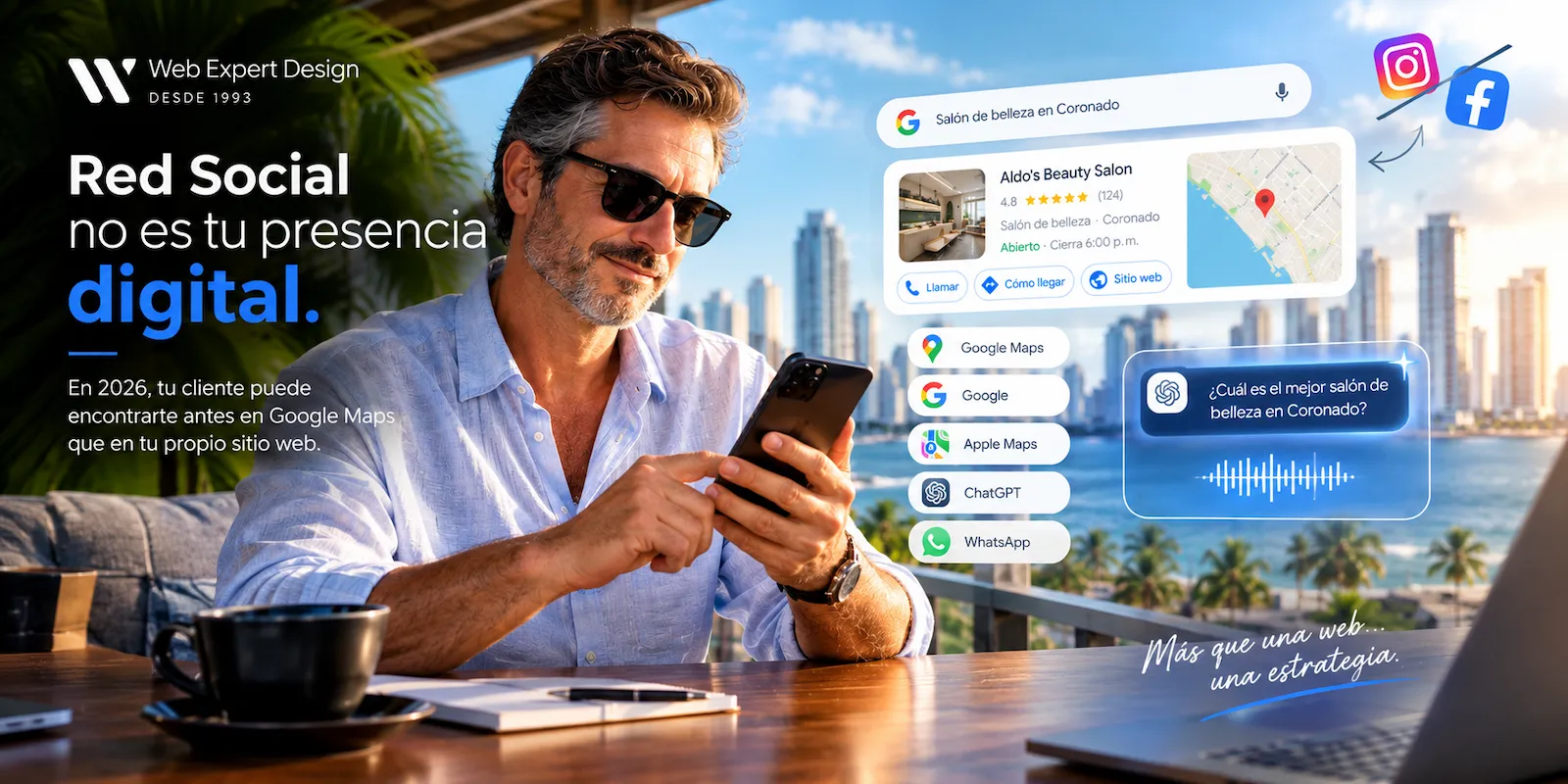
There is a widespread misconception in the business market: believing that opening a social media account equals establishing a true commercial digital presence. Although smartphone usage is universal, relying exclusively on third-party platforms creates severe operational vulnerabilities.
This is not about dismissing social media, as they are excellent visual discovery channels. It is about understanding the fundamental difference between entertaining users in a rented space and capturing high-intent customers through proprietary web infrastructure.
1. The Evolution of Local Search: From Isolated Web to Ecosystem
For years, the notion was promoted that it was enough to publish a static webpage or keep an Instagram feed active. In practice, approaching digital presence in a fragmented way creates serious flaws:
- Disconnected webpages: Slow sites, not optimized for mobile devices, or lacking local technical structure that end up invisible to Google.
- Exclusive reliance on social media: Content that expires quickly and algorithms that restrict organic reach, forcing businesses to pay for constant visibility.
- Abandoned map listings: Businesses unverified on Google Maps, with incorrect hours, or without links to a direct conversion channel.
“Having a social media profile does not mean having your own web presence. It only means you opened an account inside another company’s website.”
2. The 5 Layers of Modern Digital Presence
To ensure a company is found, understood, and chosen across search engines and maps, commercial visibility must be structured in an interconnected 5-tier ecosystem:
- Layer 01 – The Home Base: Website with its own `.com` domain, maximum loading speed, and total catalog control.
- Layer 02 – The Meeting Point: Optimized profile on Google Business Profile and Google Maps to capture geolocation searches.
- Layer 03 – iOS Coverage: Registration in Apple Maps and Business Connect for iPhone, Siri, and CarPlay users.
- Layer 04 – The New Search: Structured data in `Schema.org` code to be interpreted by artificial intelligence engines.
- Layer 05 – Direct Conversion: Immediate integration with WhatsApp Business and optimized lead-generation forms.
The key metric is never “How many likes did my last post get?”, but “How many users actively searching for my services right now can find my business when they are ready to hire?”
3. The Customer Journey: From Discovery to Real Inquiry
A professional digital ecosystem must fluidly guide the potential customer through four key conversion stages:
If any of these links break—for example, a map listing pointing to a broken site or a social media profile requiring a direct message just to know prices—the user returns to the search engine and chooses the competition.
4. Myths About Digital Presence in the US Market
There are several common myths that hold back the digital growth of local businesses:
Myth 1: “My Instagram account is enough.”
Social media is great for generating attention and visual impact, but it does not rank in structured Google searches when the user has immediate commercial intent.
Myth 2: “Appearing in artificial intelligence search requires paying for ads.”
False. AI models read the open web. If a website has a clear structured data architecture, AI can interpret the company’s information and recommend it organically.
Myth 3: “Just having the website published is enough.”
A website without local SEO optimization, a linked map listing, and technical maintenance is equivalent to opening a store in the desert: it exists, but no one can find it.
Does your business rely on rented feeds or does it have its own digital asset?
We build ultra-fast WordPress web platforms optimized to rank on Google Maps and convert search traffic into recurring customers.
Request Direct Technical Diagnosis5. Application Cases in Local Businesses
The implementation of a proprietary web ecosystem adapts to the operational demands of each commercial sector:
- Aldo’s Beauty Salon (Miami): Optimization of local presence through a fast website, structured Google Business Profile listing, and review management for capturing area residents and visitors.
- Hotel Palmar Surf Camp (Florida): Web platform optimized for direct domestic and international tourism acquisition without relying exclusively on third-party booking commissions.
- Clínica Delcor Médica (New York): Local SEO strategy, structuring of medical services in Google Business Profile, and `Schema.org` data markup for direct patient acquisition in health searches.
6. The 30-Second Google Test for Your Business
To check the degree of digital visibility or invisibility of your business, perform this quick exercise on your mobile device:
- Open your browser and go to Google.com.
- Type the exact name of your business. Does your official website and verified map listing appear first?
- Now, search for the main service you sell along with your city (e.g., “medical clinic in Miami” or “beauty salon near me”).
- Check the top three results. Does your business appear, or are direct competitors capturing those customers?
If your business does not appear in the top positions when customers search for what you sell, you are ceding market share daily to competitors with optimized digital infrastructure.
7. Direct Comparison: Social Media vs. Proprietary Web Ecosystem
We analyze the operational and strategic differences between relying solely on a social profile versus having proprietary web infrastructure:
| Commercial Factor | Social Media Dependency | Proprietary Web Ecosystem |
|---|---|---|
| User Intent | Entertainment and passive browsing | Active search for solutions and purchase intent |
| Google Visibility | None for local service searches | Ranking in Google Search, Maps, and Artificial Intelligence |
| Asset Ownership | Rented space (subject to algorithm changes) | 100% Company-owned (Domain, code, and database) |
| Service Structure | Temporary and disorganized posts | Clear catalogs, organized pricing, and simple 24/7 navigation |
| Sales Process | Requires manual replies via direct message | Continuous lead capture and customer conversion automation |
Frequently Asked Questions (FAQ)
No. The correct strategy is not replacing one platform with another, but integrating them: Social Media + Google Maps + Website + WhatsApp. Use social media to generate visual reach, but direct interested customers to your website to validate your offer and close the deal.
Google is a search engine that analyzes text, speed, structured code, and the relevance of open web pages. Social platforms are walled gardens that prevent Google from properly indexing each of your services, pricing lists, or geolocated content.
No. A professional website built on high-speed WordPress infrastructure is highly cost-effective and accessible. The required investment represents only a fraction of the sales lost by not being visible on search engines.
Take Control of Your Business’s Digital Infrastructure
Social media are excellent showcases to attract initial attention, but a proprietary website is the commercial headquarters where serious sales are closed. Leaving your company’s reputation and customer acquisition at the mercy of third-party algorithms represents an unnecessary operational risk.
At Web Expert Design, we develop ultra-fast WordPress websites with conversion architecture and local SEO, allowing businesses in the US to rank on Google, build authority, and convert searches into recurring customers.