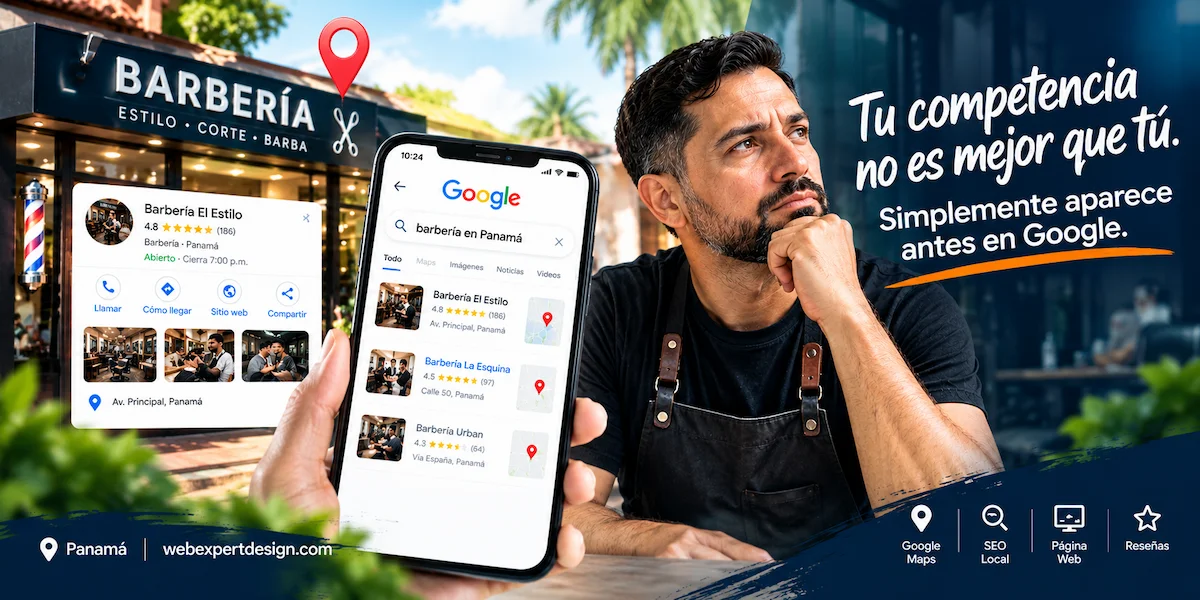
Picture this scenario: someone needs a local contractor, a medical clinic, an upholstery shop, or a restaurant. They don’t know your business, they don’t have your phone number saved, and they have no idea you exist. They pull out their phone, open Google, and search with intent: “best barbershop near me”, “dental clinic in downtown”, or “upholstery repair”.
At that exact moment, the most important commercial question isn’t whether your service is exceptional or how many years of experience you have. The real question is: Does Google have enough structured signals to display your business in the top results?
1. Being good and being visible are two completely different things
There is a deeply rooted belief among small business owners, contractors, and independent professionals: “If my product or service is great, customers will naturally find me through word-of-mouth.” It’s a noble idea, but dangerously incomplete in today’s marketplace.
The market doesn’t always reward the business with the highest technical quality. More often, customers reward the business they find first, the one that projects instant visual trust, and whose contact info is just a click away.
Delivering stellar service is mandatory for retaining a customer once they arrive. But digital visibility is the engine that makes it possible for that customer to cross your threshold (or tap your chat button) for the very first time.
2. Google Maps: Your digital storefront for local customers
For the vast majority of local businesses, Google Maps has evolved from a simple digital directory into the busiest commercial storefront in town.
When someone searches for an urgent service in their area, Google displays a map with key local listings. Within seconds, the user evaluates:
- The business name and exact category.
- Physical location and proximity.
- Phone number and direct click-to-call or chat buttons.
- Current business hours.
- Real photos of the location, team, or completed work.
- Reviews and ratings from other customers.
Simply creating a profile doesn’t guarantee top rankings. Local SEO success depends on how consistent and optimized your business information is so the algorithm understands precisely what you offer and where you operate.
Want to know what Google finds when someone searches for your business?
Web Expert Design can audit your company’s digital presence and uncover opportunities across Google, Google Maps, and your website.
Request a Free Audit via WhatsApp3. Before reaching out, your customer is already evaluating your reviews
Google reviews are not just aesthetic decorations; they are direct social proof. Today, consumers rarely contact a local business without quickly scanning recent feedback.
A serious digital reputation strategy isn’t about chasing inflated numbers or relying on positioning gimmicks. It’s about building an authentic, steady identity. Reviews demonstrate real activity, customer care, and community backing. If a competitor has dozens of recent reviews and your business profile has been sitting dormant since 2021, the trust scale tips before you even get a chance to say hello.
4. Social media shows your work. Your website explains why to choose you.
Many business owners rely solely on Instagram, Facebook, or TikTok for their digital presence. And for good reason: social platforms are fantastic for posting reels, sharing daily stories, promoting specials, and maintaining dynamic interaction.
However, depending exclusively on social media comes with an invisible commercial limit. Social feeds act like temporary display windows in a crowded mall where content gets buried within hours. A professional website, on the other hand, is your permanent brick-and-mortar storefront on the internet.
On your website, you can clearly layout who you are, what specific services you provide, your pricing structure or estimates, your exact location, and why clients trust you. Furthermore, a well-structured professional website acts as the primary anchor that fuels authority back to Google Maps and all your other digital channels.
6. Three real-world scenarios in the local market
To see how this plays out in daily business, let’s look at three common scenarios:
Scenario 1: Two contractors with identical craftsmanship
Two remodeling contractors operate in the same metro area with similar pricing and exceptional skill. Contractor A shows up in the top three results when someone searches “best home remodeling contractors” or checks Google Maps. Contractor B has superior trucks, but zero online footprint. The undecided homeowner almost always calls the option that appeared instantly on their screen.
Scenario 2: A specialized clinic
A person needs specialized medical care and searches “neurology clinic near me”. One clinic has an optimized Google Maps profile, clear photos, recent reviews, and a professional website detailing its specialists. Another neighboring clinic relies solely on an Instagram page. The gap in accessibility, information clarity, and initial trust is massive.
Scenario 3: Decades of experience vs. Digital invisibility
An upholstery master has 20 years of experience restoring luxury furniture. However, his shop has no structured web presence. When a customer searches “custom upholstery repair near me”, they find a younger competitor who is digitally visible. Craftsmanship without digital signals remains waiting in silence inside the workshop.
7. And now Artificial Intelligence also decides who exists
As if dominating Google wasn’t enough, the digital landscape has evolved. Today, more and more people use AI-powered assistants—such as ChatGPT, Gemini, and Perplexity—to ask for direct service recommendations, compare options, or plan purchasing decisions.
These tools don’t search at random; they query indexed databases and structured web sources. If your business lacks a clear, consistent, and machine-readable digital footprint, you simply won’t exist in the answers these AIs deliver to your future customers.
8. Take this 2-minute test with your own business
Don’t just guess. Open an incognito tab right now on your phone or computer and run these searches:
- Your core service + your city (Ex: HVAC repair in Miami).
- Your service + your neighborhood or specific area (Ex: Roofing contractor in Coral Gables).
- “Your service near me”.
- Your exact business name.
After searching, ask yourself these questions with total honesty:
- Does my business appear clearly on the screen?
- Is my Google Maps profile updated and active?
- Do the photos accurately represent the current state of my business?
- Do I have recent, authentic reviews from real customers?
- Does my professional website show up supporting my brand?
- Can a customer understand what I do and contact me in under 10 seconds?
Want to know what Google finds when someone searches for your business?
Web Expert Design can audit your company’s digital presence and uncover opportunities across Google, Google Maps, and your website.
Request a Free Audit via WhatsAppFrequently Asked Questions (FAQ)
Yes. Social media is great for dynamic content and short-term attention, but a website is your owned digital asset. It builds authority with Google, centralizes your business information, and protects you from third-party algorithm changes.
Changes in Google Business Profile and local SEO optimization can show local visibility improvements within a few weeks, though building lasting digital authority is an ongoing, structured process.
Not necessarily. While paid ads (Google Ads) provide immediate visibility, local organic positioning and a well-configured Google Maps profile allow you to capture local searches naturally and sustainably.
They are critical. They serve as the primary source of instant trust for consumers before they decide to contact an unfamiliar local business.
We help structure your digital presence through high-performance web architecture, advanced local SEO optimization, Google Maps integration, and proven strategies designed to turn online visitors into real clients.